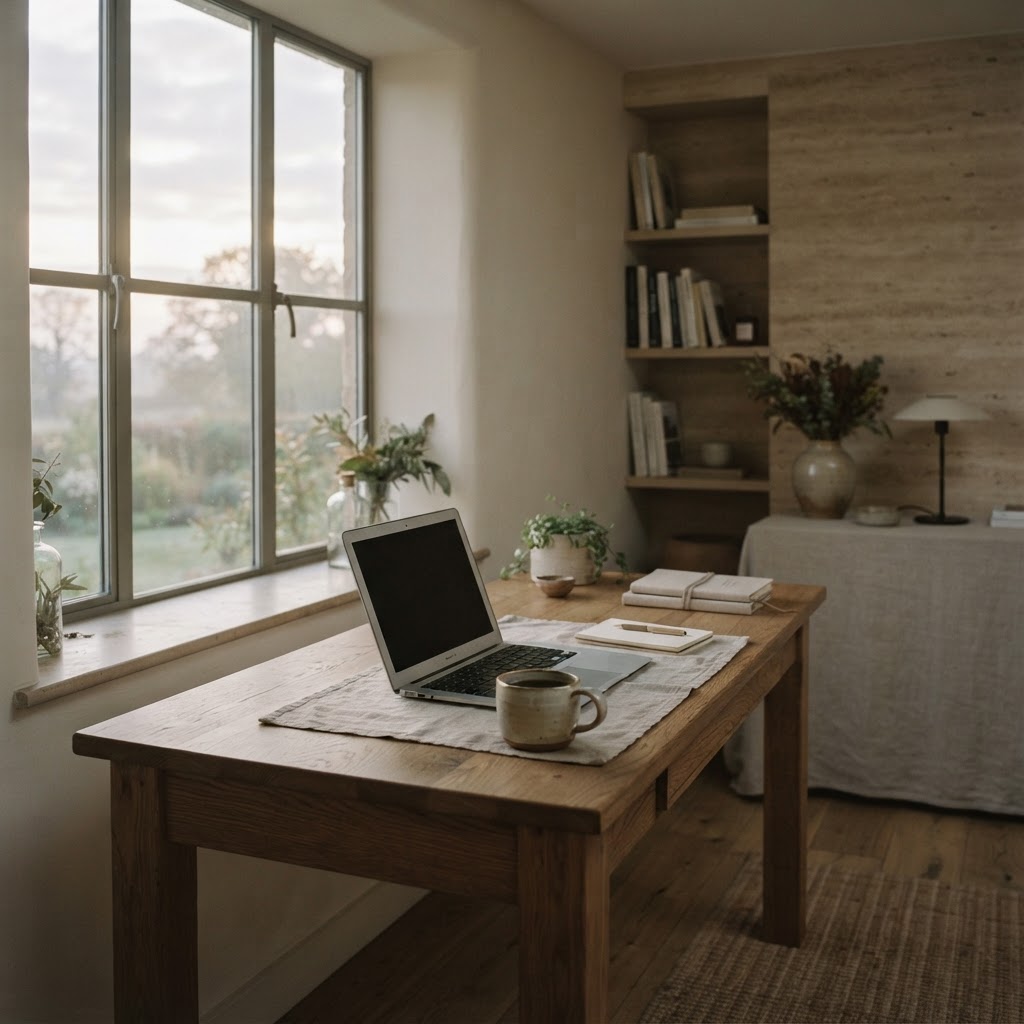
The hour before the house wakes
There is a particular kind of quiet that exists only in the first hour of the day, before a child calls out, before a phone buzzes, before the calendar asserts itself. For most working parents, this hour is not scheduled. It is simply lost — surrendered to the alarm, the lunchboxes, the hurried search for a matching sock.
Yet the families who report the greatest sense of calm in their mornings almost all share one habit: they have learned to protect a sliver of that first hour for themselves. Not for work. Not for the children. For the adult.
Why the first hour sets the tone
The nervous system is remarkably porous in the minutes after waking. Whatever you meet first — a notification, a news headline, a rushed demand — tends to colour the next several hours. It is the difference between meeting the day and being met by it.
This is not about waking at five. It is about the quality of the first hour you do have. A parent who begins the day in a state of low-grade reactivity tends to carry that current through the school run, the first meeting, and the tone of the household itself.
What the hour is — and is not
The protected hour is not a productivity sprint. It is not the time to answer email or rehearse the day's difficult conversation. It is a buffer: a few minutes of stillness, a slow coffee, perhaps a walk, perhaps nothing at all.
The point is simply this: that the first demand on your attention is something you have chosen, not something that has chosen you.
A small, realistic practice
You do not need an hour. For many families, twenty minutes is enough. The practice is to decide the night before what those minutes will hold, and to defend them from the morning's first intrusion.
- Wake before the household, even by fifteen minutes.
- Leave the phone in another room until the hour is over.
- Choose one anchor — a drink, a stretch, a page of reading — and let it be the whole task.
- Let the children's wake-up be the end of the hour, not the beginning of your day.
The downstream effect
It sounds small. It is not. Parents who hold this window describe a different relationship to the rest of the day: less reactive, more deliberate, more present with the people who arrive at the breakfast table.
A calm morning does not guarantee a calm life. But it changes the starting point — and for a household running on many demands, the starting point is almost everything.