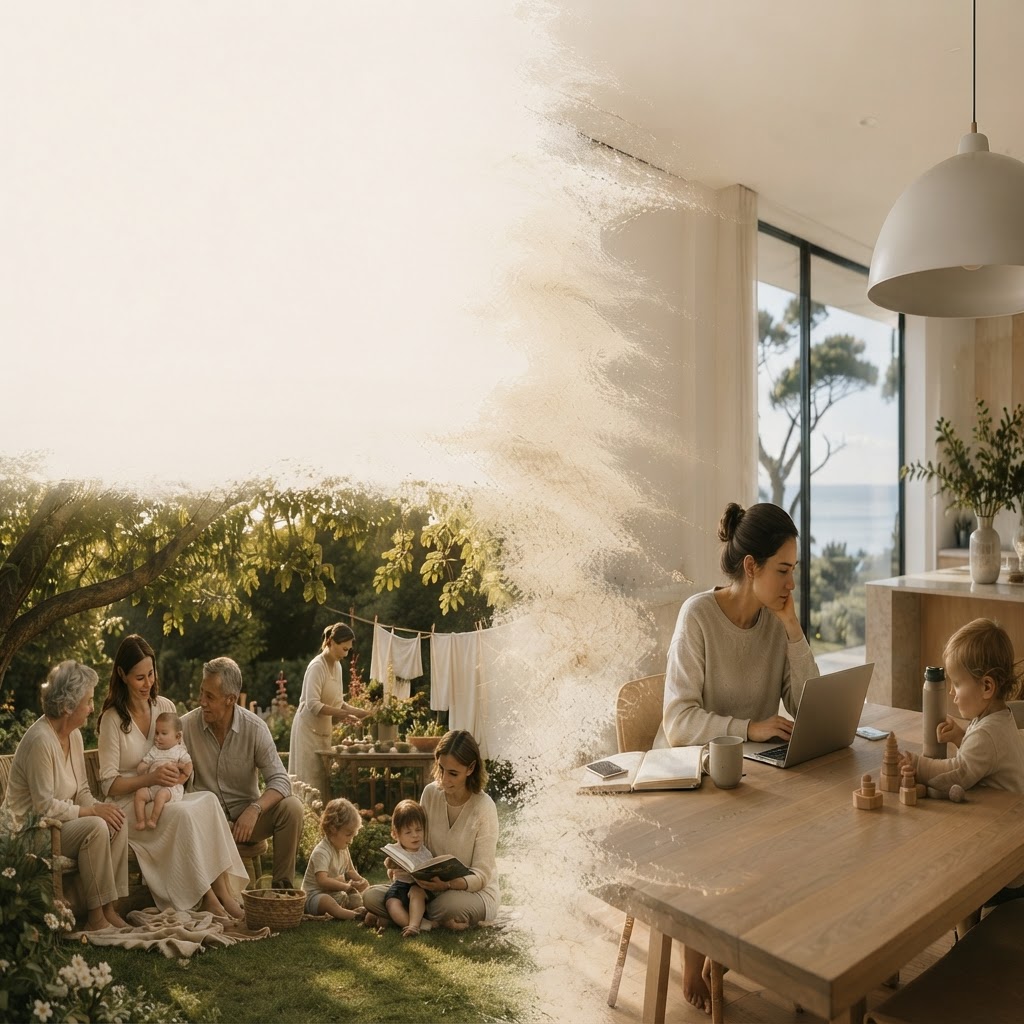
The village we remember
There was a time when raising a family didn't feel like a solo endeavour. Grandparents lived nearby. Neighbours knew your children by name. Teachers carried them from one year to the next. There was a web of people — a village — that held the ordinary weight of family life.
It wasn't perfect. It wasn't always convenient. But it meant something: when you were tired, someone else could step in. When you were uncertain, someone with more experience could offer perspective. The village wasn't a luxury. It was the architecture of a functioning family.
What changed
The village didn't collapse overnight. It eroded slowly — through migration, through longer working hours, through the fragmentation of community. Families moved further from their support networks. Grandparents remained connected by phone but no longer around the corner. Neighbours became strangers. The informal structures that once carried families through difficult seasons quietly disappeared.
But here's what's striking: our expectations didn't adjust. We still carry the belief that we should be able to manage — that a capable parent handles it all. We compare ourselves to a version of family life that no longer exists in the same form, and we judge ourselves for falling short of a standard that was never designed to be met alone.
The expectation gap
This is the gap we see most often in our work: the distance between what families expect of themselves and the support they actually have. It's not a gap of capability. It's a gap of infrastructure.
The most accomplished parents we work with — leaders in their fields, people who build teams and manage complexity with extraordinary skill — find themselves surprised by how hard the domestic landscape feels. Not because they lack the intelligence or resilience. Because they're operating without the village their parents had, while holding expectations shaped by a world that has fundamentally shifted.
What we're really asking for
When families come to us, they often frame the conversation in practical terms: childcare, routines, household systems. But beneath the practical request is something more fundamental — a longing for the kind of trusted support that allows a family to breathe.
They're not asking someone to do everything for them. They're asking for the village. For people they trust. For systems that hold things together when life gets full. For the confidence that comes from knowing they're not navigating it alone.
A new kind of village
The village we grew up with may be gone. But the need it served hasn't changed. The question isn't whether we can go back — we can't. The question is what we build in its place.
Because the truth is, extraordinary family life was never built by one person. It was always built by a village. And the most intentional families today are the ones who recognise that — and choose to build their village, on purpose, with people and systems they trust.